See more on our Facebook page:

Thursday, October 31, 2024

Bringing Animals Back from Extinction


Bringing Animals Back From Extinction. Science or Fiction? 

by Zhihan Shi


The famous movie franchise Jurassic Park is all about bringing dinosaurs and other famous extinct animals back from the dead. The first movie was made in 1993, and bringing extinct animals back in just three decades is a bigger possibility than ever. While scientists are not bringing extinct animals back just yet, biotechnology has made significant progress in de-extinction. De-extinction is a field of science involved in resurrecting species that have gone extinct (Carrington). 

The Science Behind De-extinction

How exactly does de-extinction work? A paraphrased definition of de-extinction by The International Union for Conservation of Nature (IUCN) is that it is the ecological replacement of an extinct species by adapting a living organism to serve the ecological function of that species through various means. Essentially, bringing back an extinct organism requires an existing living organism, preferably one closely related (Neuman).

Cloning, also known as somatic cell nuclear transfer (SCNT), is one of the main techniques utilized in de-extinction. This procedure involves inserting the nucleus of a somatic cell from the extinct species into an egg cell whose nucleus has been removed. After that, the egg is encouraged to grow into an embryo that can be placed inside the body of a closely related species' surrogate mother (Neuman). The famed Pyrenean ibex, an extinct subspecies of the Spanish ibex, was used to test this technique; however, the cloned animal died shortly after due to a lung defect (Brian). 

Another technique is genetic engineering, in which researchers modify the DNA of a closely related extinct species by inserting genes from the extinct species, producing an organism that is strikingly similar to the original. Tools such as CRISPR-Cas9 are used in this process. As Dr, Carina Schlebusch puts it, “The genome editing approach is the most viable and, with the availability of DNA-editing techniques such as CRISPR–Cas9, it may be feasible in the near future.” By altering the genome of the Asian elephant, the woolly mammoth's closest living relative, it may be possible to revive the mammoth (Schlebusch). 
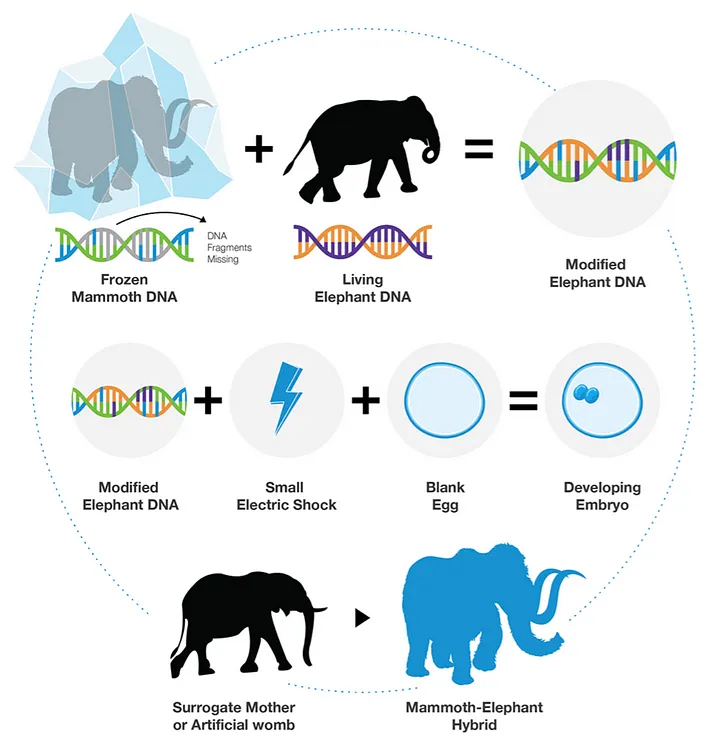


A proposed outline of bringing back the mammoth using biotechnology. 

Source: https://www.worldwildlife.org/

Current Examples of De-extinction

Many companies and researchers are trying to be the first to perform de-extinction. A notable example of de-extinction is the endeavor to bring back the woolly mammoth. To produce a hybrid with the mammoth's cold-resistant features, such as thick fur and subcutaneous fat, scientists are attempting to insert mammoth genes into the Asian elephant's genome. By promoting grassland ecosystems in the Arctic tundra, this initiative, headed by Harvard scientist George Church, aims to create a mammoth-elephant hybrid that may be released into the wild to aid in the fight against climate change. A similar project was done by the company VOW, where they created a mammoth meatball using extinct animal DNA (Carrington). 

Another example is the attempt to bring back the passenger pigeon, a species that was once abundant in North America but went extinct in the early 20th century due to overhunting and habitat destruction. Scientists are using genetic material from preserved specimens to attempt to recreate the species by editing the genome of the band-tailed pigeon, a close relative of the passenger pigeon (Novak). 
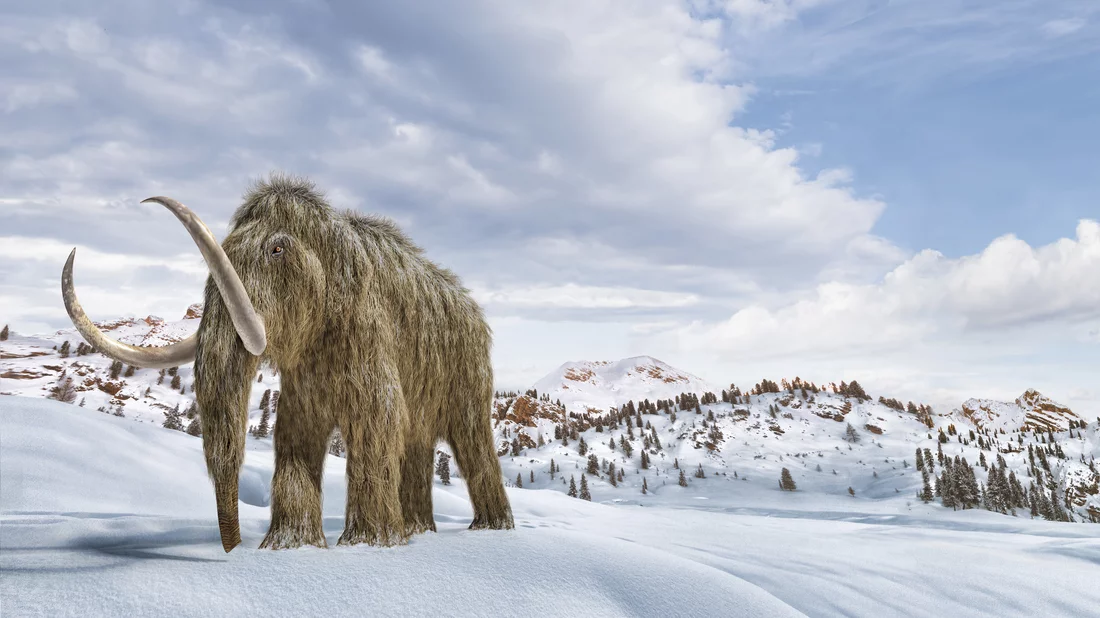
Figure 1: A depiction of the woolly mammoth

Source: www.NPR.org

Conclusion

De-extinction is a promising new field that may see success in the upcoming years due to biotechnological breakthroughs. Different scientific methods have been proposed for de-extinction and it is only a matter of time before one succeeds. As new projects arise for bringing back extinct animals, the ethics of these experiments may need to be called into question. In my next blog post, I will cover more on the future of de-extinction, including new technology like AI and ethical dilemmas. Stay tuned! 


Citation:

Brian, Thomas. “Extinct Ibex Clone Dies at Birth.” ICR, https://www.icr.org/article/extinct-ibex-clone-dies-at-birth/. Accessed 4 Sept. 2024

Carrington, D., & editor, D. C. E. (2023, March 28). Meatball from long-extinct mammoth created by food firm. The Guardian. https://www.theguardian.com/environment/2023/mar/28/meatball-mammoth-created-cultivated-meat-firm. Accessed 4 Sept. 2024

Martinelli, L., Oksanen, M., & Siipi, H. (2014). De-extinction: a novel and remarkable case of bio-objectification. Croatian Medical Journal, 55(4), 423–427. https://doi.org/10.3325/cmj.2014.55.423. Accessed 4 Sept. 2024

Neuman, S. (2021, September 15). Scientists say they could bring back woolly mammoths. But maybe they shouldn’t. NPR. https://www.npr.org/2021/09/14/1036884561/dna-resurrection-jurassic-park-woolly-mammoth. Accessed 4 Sept. 2024

Novak, B. J. (2018). De-extinction. Genes, 9(11), 548. https://doi.org/10.3390/genes9110548. Accessed 4 Sept. 2024

Schlebusch, C. M. (2022). Genomics: Testing the limits of de-extinction. Current Biology, 32(7), R324–R327. https://doi.org/10.1016/j.cub.2022.03.023. Accessed 4 Sept. 2024

About the Author

My name is Zhihan Shi and I’m a senior at Innovation Academy. I’m interested in biotechnology and I’ve been learning about it through classes at my school. Inside of biotechnology, I’m interested in microbiology and molecular biology. 

Zhihan Shi | He/Him

https://www.linkedin.com/in/zhihan-shi-01aa85271/

zhihankshi@gmail.com


Friday, October 11, 2024

Identifying Common Potomac Tree Species in Winter

adapted from the Potowmack Chapter of the Virginia Native Plant Society:


Even when the leaves are not on the trees, you can still identify them by their bark. Here are some common trees in our region that can be identified by their bark. All of these are alternate-branched. For opposite-branched trees, memorize the acronym "MAD-Cap-Horse Buck" for Maple, Ash, Dogwood, the family Caprifoliaceae (honeysuckles and viburnums, mostly shrubs), and the Horse chestnut or Buckeye (Genus Aesculus).

Tuesday, September 17, 2024

Wednesday, August 7, 2024

Here comes the water!


Saturday morning will likely reach the Action Stage. 


Tuesday, August 6, 2024

Drought throughout the Potomac Watershed

from the ICPRB:

 Regional Drought Watch declaration, algae blooms, putting blue catfish on the menu, and more, in this week’s Potomac News Reservoir – August 1, 2024 >>>

River Report – Drought Watch declared for DC Metro Area

On Monday, the Drought Coordination Committee of the Metropolitan Council of Governments (COG) declared a Drought Watch for the DC Metro area which calls for voluntary water conservation measures by the region’s residents and businesses. This is the second level in COG’s four-stage regional drought response plan.

Read ICPRB’s News Release about the Drought Watch >>>

The most recent U.S. Drought Monitor map shows almost 90% of the watershed is experiencing moderate to extreme drought conditions. The extreme drought conditions are concentrated in the western part of the watershed.

Governor Justice of West Virginia declared a state-wide State of Emergency due to impacts from drought.

At least 92 counties and cities in Virginia are in either Drought Watch or Drought Warning status.

The Maryland Department of the Environment declared a Drought Watch for the western part of the state.

Most smaller jurisdictions across the Potomac watershed are a asking folks to voluntarily minimize their water use to reduce the stress on local streams and groundwater. Some cities are imposing mandatory water restrictions.

A Comprehensive Look at Water Use in the Potomac Basin

When the Potomac Basin Comprehensive Water Resources Plan identified a possible inadequacy in the understanding of water-use on a watershed-wide level, ICPRB staff looked into it. The resulting paper, recently published in the Journal of the American Water Resources Association, investigated if the full spectrum of water uses is known —  and needed — in order for sustainable management of water resources.

Read the report: Evaluation of reported and unreported water uses in various sectors of the Potomac basin for the year 2017 >>>

Monday, August 5, 2024

Registration Open for the 2024 Potomac Conference

 **Registration is Open**

2024 Potomac River Conference: Reeling in the Challenge of Aquatic Invasive Species

8:30 am – 3:30 pm

October 17, 2024

River View at Occoquan in Lorton, VA.

Join the Interstate Commission on the Potomac River Basin for a conference that will expound on the science, policy, and management of invasive fishes and other aquatic species in the Potomac River basin.

Click here for a PDF of the agenda >>>

Click here for more information and registration details >>>

Our relationship with invasive, non-native aquatic species in the Potomac River basin is complicated. Alarms are sounded and eradication efforts mobilized for some species (zebra mussels, blue catfish), while concerns about other non-native species fade as they fill empty ecological niches (Asiatic clams) or become prized fisheries (smallmouth bass). The goal of this effort is to convene a one-day, in-person conference to enhance awareness of the ecological roles that aquatic invasive species have or could assume in the Potomac River basin and the adverse impacts they impart when natural controls are missing.

The day will start out with an invasive species case study of blue catfish and lead into research on other invasive species in the Potomac River.

We have extended the deadline for poster presentations. Please submit an abstract if you are interested in having a poster at the event.

Saturday, July 27, 2024

Invasive cattail leaf rockets


 Invasive cattails, especially Narrow-leaved Cattail (Typha angustifolia)
 grow rapidly and crowd other plants species, and also provide poor habitat.  But they can make great leaf rockets.  Click on the image (right) or on this link: 
facebook.com/share/r/iM4tsnTwPHX9h9Ui/ 

to see the simple trick.


Saturday, July 20, 2024

Guest Blogger Amelia Keng: How can technology-research reduce droughts in California?

How can technology-research reduce droughts in California?

By: Amelia Keng


Photo Source: World Atlas

For many years, California has not had an abundance of water. Climate change is only making conditions worse for farmers, city dwellers, and nature as they continue to have a lack of water. According to drought.gov, as of 2022, the state of California is experiencing 99.77% of moderate to exceptional drought. This means that around 37,243,577 of Californians are in drought, due to the significant lack of precipitation and groundwater. Although in the past years, California has seen a

Sunday, May 5, 2024

Sealed Terrariums

In 1960, David Latimer planted a spiderwort sprout inside of a large glass jar, added a quarter pint of water, and then sealed it shut. He opened the bottle for the first time only 12 years later, in 1972, to add some water and then sealed it for good. 

The self-contained ecosystem flourished for more than 60 years as a perfectly balanced garden and self-sufficient ecosystem. 

The bacteria in the compost ate the dead plants and broke down the oxygen released, turning it into carbon dioxide, essentially forming a microcosm of Earth. 

For teachers:  This is a great project at the end of the year. It doesn't have to be this big, and it can even be a sealed aquarium (terrarium).  Next Fall you can invite your former students to stop in to see it.  To add a little more excitement, many types of insects, spiders, worms, snails and even flies can survive in a closed terrarium. Springtails, earthworms and woodlice are found in most closed terrariums.